





In 1997, in the years before The Wire, Game of Thrones, and Succession, HBO was an upstart in search of a hit. It took a chance on a script by David Chase about Tony Soprano, a New Jersey mob captain in need of therapy, that over six seasons would grow into one of the network’s crown jewels.
A new show at the Museum of Moving Image (MoMI), “Stories and Set Designs for The Sopranos,” captures the urgent energy channeled by Chase and his team of collaborators as they turned daring pilot into a show that would pave the way for a golden age of television.
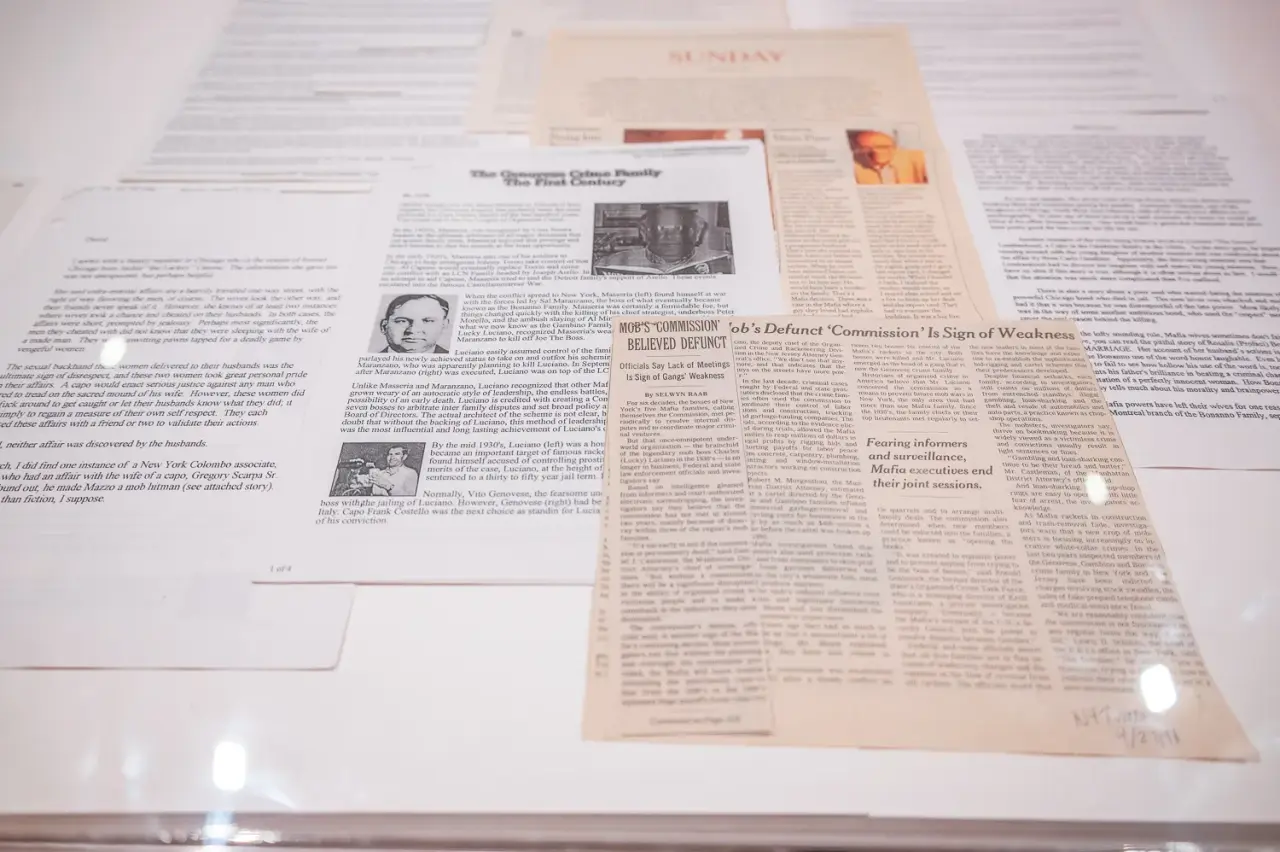
At its heart is a display case shows the team frantically swatting up on their knowledge of the Italian-American underworld in the months leading up to the filming of the pilot. There are clippings on the Genovese crime family, notes titled “Wiseguy Research,” and a document assigning characters their place within the mafia hierarchy. Chase may have been inspired by the northern New Jersey community he grew up in, but the research went deep. In one case, someone probes their connections in the Chicago crime network to learn about marital infidelity. “The wives look the other way,” the source reports.
The surrounding four walls are dedicated to the spaces in which the drama unfolds: the Soprano family home, the Bada Bing strip club, Dr. Melfi’s psychiatry office, and the meat market that doubles as a Mafiosi meeting place. For the pilot, all but Melfi’s office had been shot on location and so for the first season, the production designer, Dean Taucher, recreated them at Silvercup Studios in Queens—Chase insisted, however, that all exterior shots take place in New Jersey. For each location, the curators provide an episode clip and its script along with concept art and ground plans, which have been in the MoMI’s collection for some time.
“By joining the design materials to the writing materials we wanted to provide a closer look at how The Sopranos, and a television series more broadly, moves from that initial pilot stage into series production,” the exhibition’s curator Barbara Miller said over the phone. “It uncovers the mystery of how these things happen. It’s work; it’s not magic.”
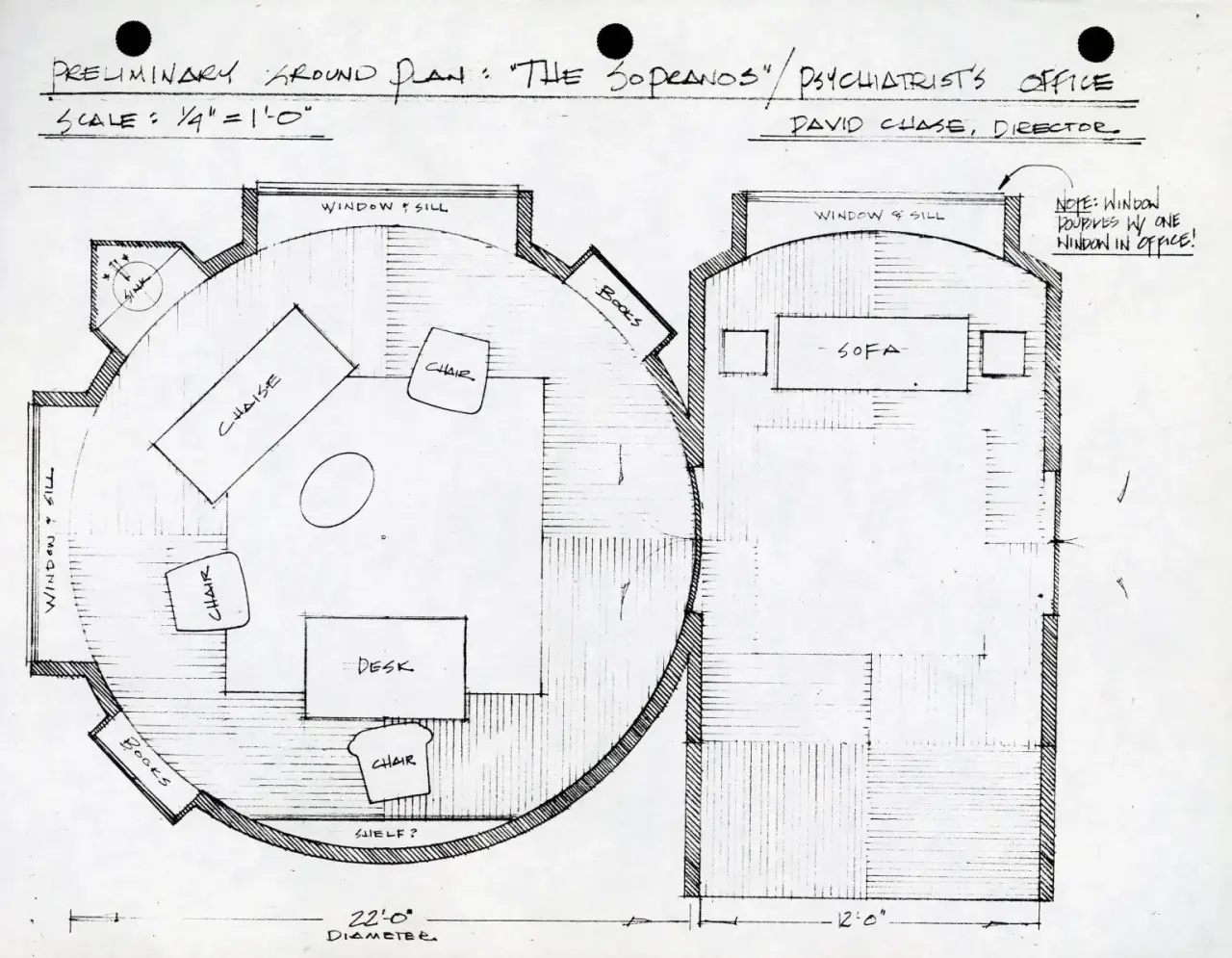
By the late 1990s, audiences were familiar with meeting America’s mafia men on screen, but what immediately set The Sopranos apart was the psychological element. This plays out in Melfi’s office in which Tony (played by James Gandolfini) haphazardly shares the anxieties of his profession and what might modestly be called “mother issues.” Ed Pisano’s original design—drawings of which were previously gifted to the museum—is a thing of hardwood and cold lighting, an austere circular space with no escape. “Look,” Tony said in the pilot, “it’s impossible for me to talk to a psychiatrist.” The viewer knows otherwise.
A focus of these sessions is Tony’s tension with his mother Livia (Nancy Marchand), a character loosely inspired by Chase’s own eccentric mother. As the exhibition reveals, Chase originally planned on having Tony kill his mother at the end of the season, but this changed owing to the strength of Livia’s character and Marchand’s relationship with the production.

The contrast between their respective homes shows that Tony has surpassed the success of his father, Johnny. Whereas Livia’s house is a generic middle-class box, her son lives in a sprawling suburban mansion with faux-Renaissance paintings (by Michael Zansky), crystal wall lamps, and a swimming pool. It’s a space meant to act as a refuge, as shown in a concept drawing of Tony stood at the top of his foyer staircase surveying his home in a tight-fitting polo shirt and topped by a halo.
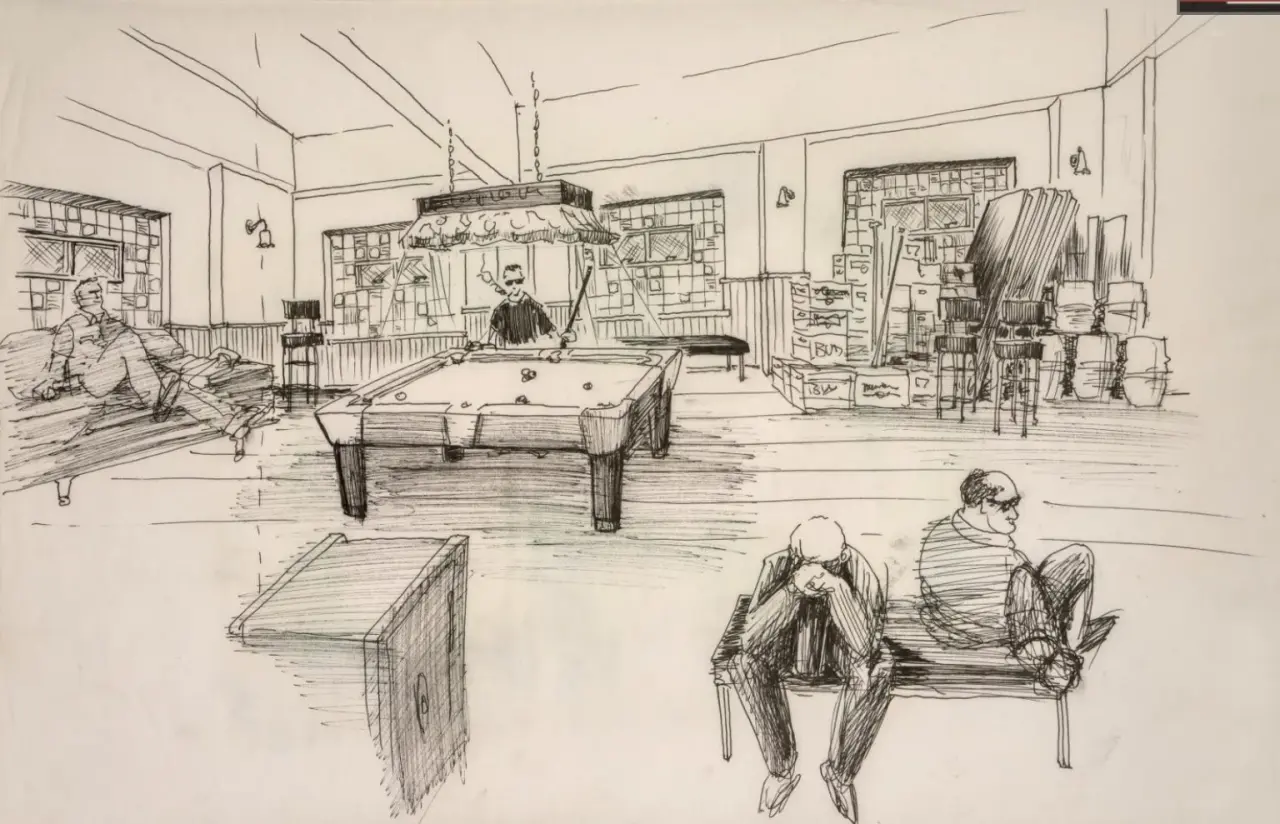
The Bada Bing strip club and Satriale’s Pork Store work to pierce the veneer of any such respectability. The backroom of the strip club, whose sign was drawn from truck mud flaps, is on the nose with dim lighting, a pool table, and risqué posters. Likewise, Satriale’s recreates a meat market in Elizabeth, New Jersey, that had been used to shoot the pilot. To do so, they took over a plot in the nearby town of Kearny—though they did add a smiling pig to the roof.
Over the course of its eight-year run, details like these became intimately familiar to viewers. One detail that did change was the show’s logo. The downward facing gun originally mimicked the letter “r.” This was deemed “cheesy 007 James Bond” and certainly not the first impression the showrunners were going for.
“That golden age was not just about the excellence of the show itself, but a product of the conditions of the industry at that moment,” Miller said. “The Sopranos connecting with HBO in that dynamic moment was fortuitous, both for them and for us as viewers.”

“Stories and Set Designs for The Sopranos” is on view at the Museum of Moving Image, New York, February 14–May 31.